Preserving the Wonder of Childhood: Sharon Jayakumar Built the School She Couldn’t Find
Sharon Jayakumar founded The Aspen Grove School, a South Philly community rooted in wonder, after struggling to find childcare. She also co-founded Bhagya Trust, which has helped over a thousand girls in her Indian hometown.

Twelve years ago, Sharon Jayakumar was a mother of an 18-month old toddler with a demanding, travel-heavy corporate job. She had a very specific problem. She could not find childcare for her son that felt right. She toured program after program looking for a well set up physical environment with natural light and daily outdoor time. She wanted a philosophy that recognized her son and other children as capable and curious, not as a child to be managed. She was met with either programs that did not embrace these aspects or ones with very lengthy waitlists. “We joke at Aspen Grove that you need to get on the wait list on your first date,” she says, only half joking, about just how scarce that kind of care was, and still can be, in Philadelphia. What she found, again and again, was a gap between what young children actually need and what most programs were built to deliver.
So she built the thing herself. Today, Jayakumar is the founder of The Aspen Grove School, a Reggio-inspired, urban nature-based early learning community in Graduate Hospital, entering its 10th year of operation. It serves children from six weeks to five years old. She is also the co-founder of Bhagya Trust, a nonprofit she runs with her mother. Together they have educated and mentored girls from the slums of Bangalore, India, for nearly two decades. She is a mother of two, a masterful multitasker, and someone who, by her own description, is still trying to figure out the balance rather than someone who has it all figured out. It is that mix of builder, mother, mentor, that makes her one of Philadelphia Family’s 2026 Women of Influence.
Sharon Jayakumar is a 2026 Philadelphia Family Women of Influence Award Winner
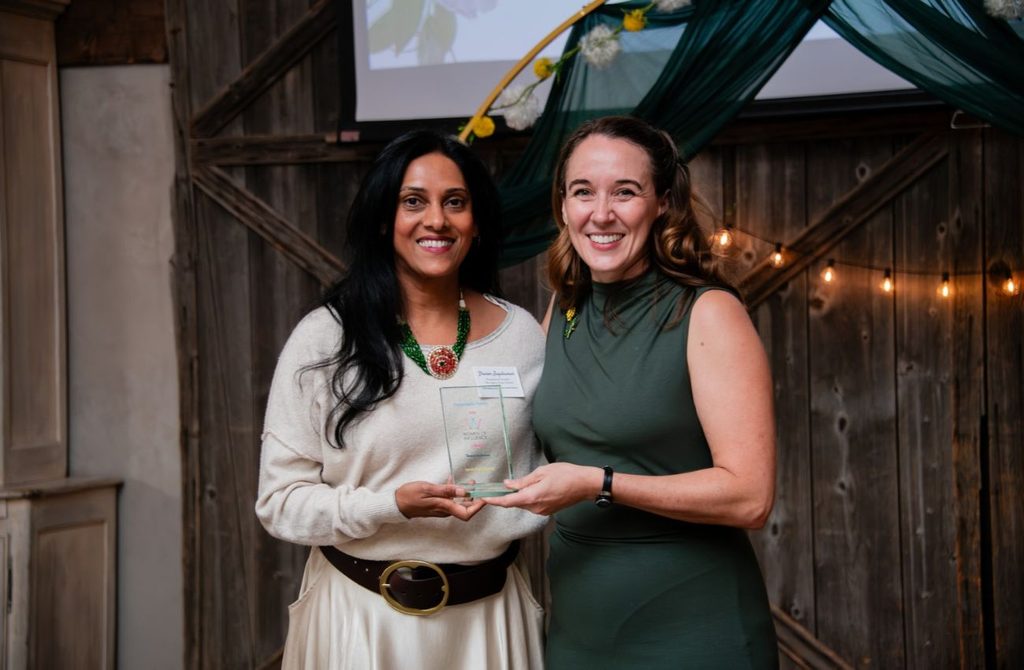
Philadelphia Family’s Women of Influence Awards celebrate exceptional women making significant impacts in our community. Sharon was nominated by a colleague, Jade Wagner, and selected based on her achievements and dedication to creating positive change. Each Women of Influence Award Winner has committed to support Family Focus Media’s core values. Together, we are committed to fostering a sense of belonging and empowerment for all families. All backgrounds, races, genders, and sexual orientations are welcome and safe with us.
Beyond the awards, our Women of Influence Luncheon and Speed Networking Night attendees come together as our Women of Influence Network, a community fostering connections, collaboration, and mutual support.
Building It From First Principles
Jayakumar had no formal background in early childhood education when she started out. “I didn’t know what Reggio meant, I didn’t know all the terms,” she says of those early days. What she had instead was a philosophy. She believed that childhood is not a waiting room for adulthood, but a meaningful stage of life in its own right. She credits Erika Christakis’s book The Importance of Being Little with sharpening that instinct into a mission. The phrase became the school’s first core value.
She met her eventual co-founder, physical therapist Micah Straight, almost by accident. They connected during her son’s PT sessions for a minor neck condition. “I was on maternity leave and we would talk about the need for high-quality places that helped children, young families,” she recalls. Those conversations turned into a search for a physical space. Finding the right location took two years. They eventually found and converted a historic church at 1600 Christian Street. She selected this spot deliberately for its natural light and beautiful physical environment that included restored stained glass and wooden beams. It also had room to build three dedicated gross motor spaces where children of different age groups could move, climb, and tumble.
Faith, Not Certainty
Jayakumar’s grandmother helped raise her in Bangalore, and she credits her grandmother with instilling much of her resilience. Her grandmother died just days before Aspen Grove opened its doors in 2017.
“She knew I was opening the school and she sort of breathed her blessing into it,” Jayakumar says. She spent day one at her grandmother’s funeral in India instead of at her own school’s launch. It’s a detail that captures how much of Aspen Grove’s foundation ran on faith rather than certainty.
What followed was not a straight line. The school grew to serve nearly 150 children when the pandemic hit. “Practically overnight, we closed a thriving school. When we reopened a few months later, only 32 families returned,” Jayakumar recalls of that period. Bills mounted, staffing thinned, and a business partnership did not go as planned. “There was a period when I truly believed it might not [survive],” she says. What carried her through was not one turning point, but an accumulation of small ones. A teacher who kept showing up because she believed in the mission. A parent who stayed loyal through the uncertainty. An entrepreneur’s story of failure and recovery that gave her language for her own. “So I kept going. One step at a time. One problem at a time,” she says.
Nearly a decade since inception, Aspen Grove serves 200 children. In Jayakumar’s words, it has become less an operation and more of a cause. “We don’t own an operation. We say that we own a cause, and our cause is to preserve the magic and wonder of childhood,” she says. That mission shows up in many details her nomination highlights. Jayakumar supports her staff, giving them room to grow rather than just managing them. She hosts monthly family coffee chats and quarterly events to knit the school’s families together. Her school’s admissions philosophy treats parents as partners, not customers.
What a Day at Aspen Grove Actually Looks Like
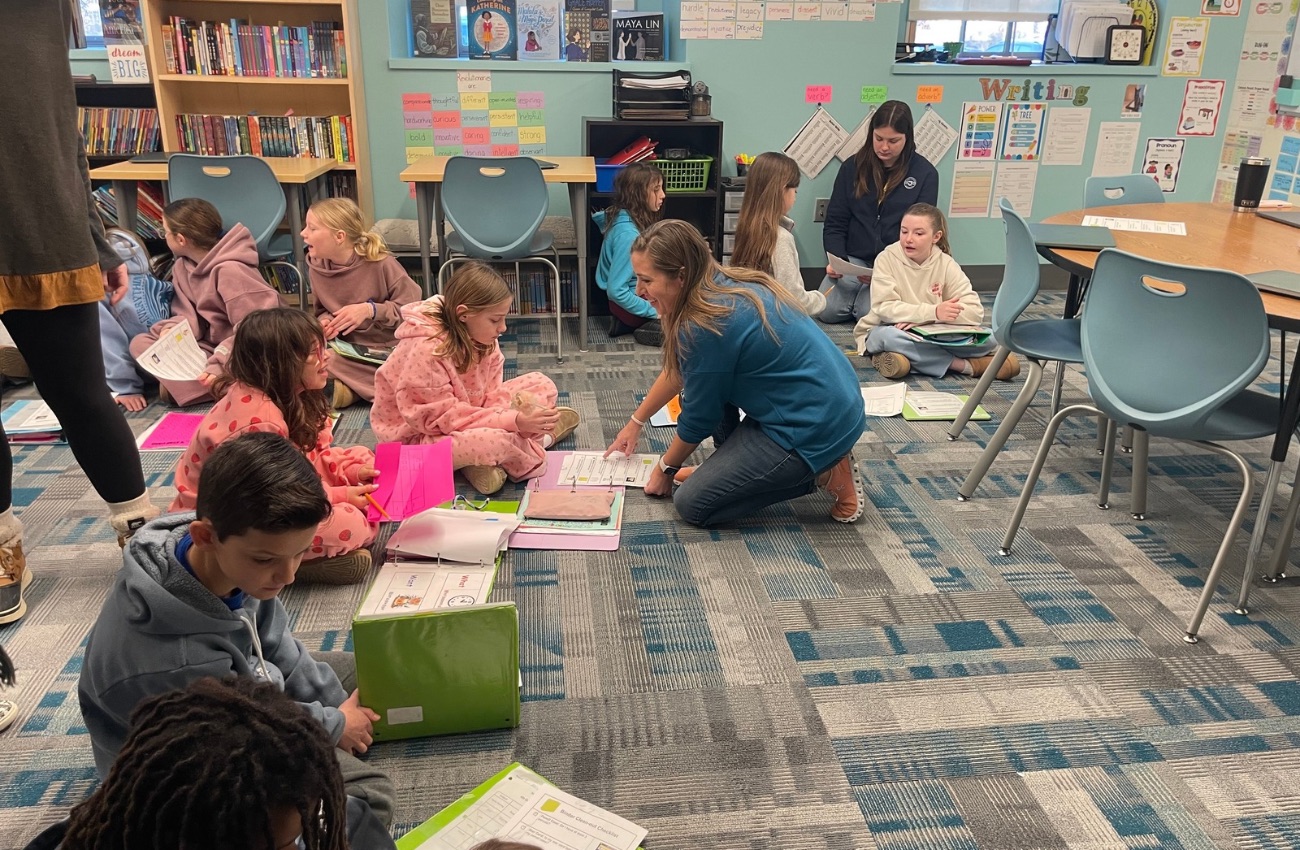
Ask Jayakumar what sets Aspen Grove apart and she does not lead with curriculum. She leads with how children are seen. “You want your image of the child, and everyone that works at the school to have an image of the child, as capable, curious, and competent,” she says. She is describing the Reggio Emilia philosophy that underpins the school’s program. Teachers are trained to be “a guide on the side, not a sage on the stage.” They step back to observe what a child gravitates toward, rather than directing every activity.
That includes daily outdoor time, rain or shine, within the limits set by Philadelphia’s Department of Human Services. “I found that many schools said that they go outside every day. But they didn’t,” Jayakumar says. She understands why administrators hesitate. City parks come with real hazards. But she considers it non-negotiable. “It’s just very fundamental to a child’s learning experience to be able to go out and to move and to have an intentional connection with nature.”
The payoff, she argues, is not despite the play but because of it. “Children don’t learn to sit still and listen to the teacher by sitting still and listening to the teacher,” she says. “They learn to eventually sit still and listen because they are allowed to move, and their core strength has developed.” It’s a philosophy she works to partner with parents on through Aspen Grove’s “Rooted Parent” education series. The series tackles an anxious, universal question: will a child-led, play-based approach leave kids ready for kindergarten?
The Family Behind the Founder

Jayakumar’s children, now a teenager and a pre-teen, were part of the school’s origin story from the start. Her son was the reason she began looking for a school in the first place. Her daughter was born the year before Aspen Grove opened its doors and attended the school, taught by 2 teachers who are still a part of the school.
She is candid that living her own values at home is a daily practice, not a finished accomplishment. “I can’t say that I do it 100 percent well at all times. I can always be better, but I really try to be intentional with the time that I have with them,” she says. Her son has started holding her accountable when she reaches for her phone. “Now my son will say to me, ‘is it an emergency?’ And that’s my cue to put it aside.” She points to a core piece of Aspen Grove’s teacher training that guides her own parenting too: “Your voice becomes their inner voice, and that’s an honor.”
Her husband, a small business owner himself, has been a steady partner through the harder years. “I think when someone deeply believes in you, it’s so game-changing,” she says of her husband. When she told him about the Women of Influence honor, his response stuck with her: “He said to me, ‘you’ve already won. To me, you’re already that person.'”
Outside of work and family, Jayakumar enjoys running, not competitively, but for the quiet. “It’s the solitude, the thinking time, being in nature,” she says. She is also a longtime fan of documentary film, with a quiet hope of making one herself someday.
A Second School, Half a World Away
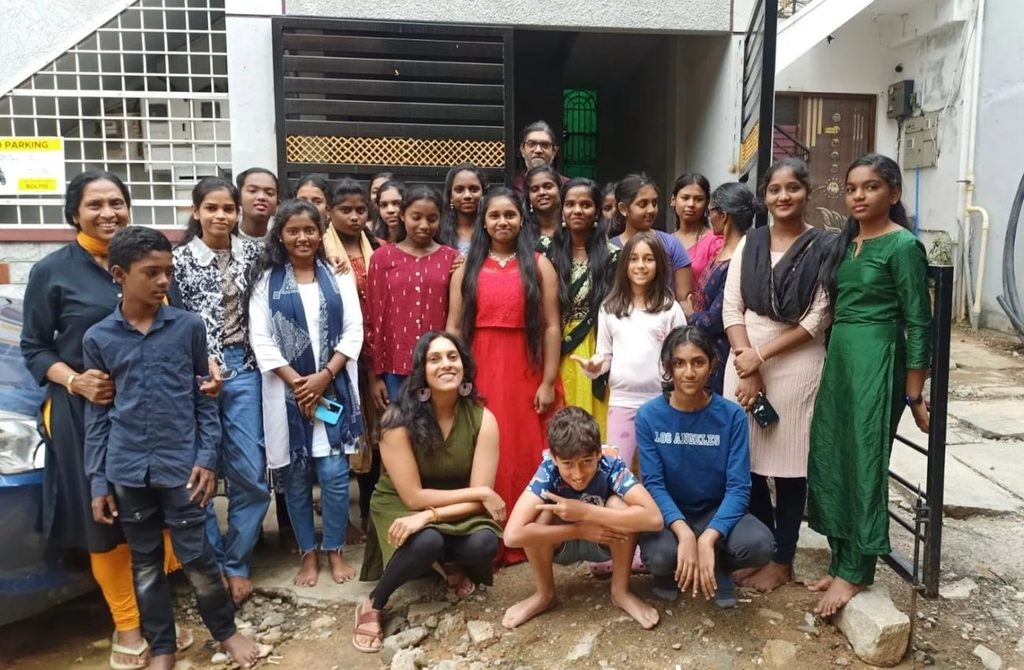
Long before Aspen Grove existed, Jayakumar was already involved in education, just on a different continent. For eighteen years, she and her mother have run Bhagya Trust, a nonprofit supporting girls and young women in the slums of Bangalore, the city where Jayakumar was raised primarily by her mother and grandmother. The name, in the Tamil language, means “luck” or a “second chance.” It is also her grandmother’s middle name. The organization’s model combines education, healthcare, and mentorship. A portion of Aspen Grove’s proceeds goes directly toward funding it.
“My mom and I are BFFs,” Jayakumar says of the partnership. It runs on a standing Wednesday call across a nearly twelve-hour time difference and an annual trip back to India. Bhagya has supported more than a thousand girls over its history and currently mentors 118, along with a small number of boys. The focus stays on girls deliberately, Jayakumar says, because in many households, “when there is economic duress, the first person to not get an education is the girl.”
One story has stayed with her. A girl entered the program as a child having witnessed severe domestic violence rooted in her father’s alcoholism. She had internalized the belief that her future was already decided. “She did not see herself as someone with choices, opportunities, or unique gifts,” Jayakumar says. Bhagya supported her education and connected her with counselors to process her trauma. Staff surrounded her with adults who repeated a message she had rarely heard: “You are capable. Your story does not define your future.”
Today, that young woman is a department lead at an IT company. “What moves me most is not her professional success,” Jayakumar says. “It is the confidence with which she now navigates the world.”
Bhagya’s work with mothers has included small microfinancing experiments. Many of these mothers are single parents who lost domestic work during the pandemic. The microfinancing allowed women to set up roadside tea and food stalls when formal jobs disappeared. “Nobody threw up their hands in despair and said ‘I don’t have a job anymore,'” Jayakumar notes. “They all hustled.”
What She’d Tell the Woman Still Searching
Jayakumar is quick to point out that Aspen Grove and Bhagya are not backed by a franchise or deep-pocketed investors. Both exist because people decided to bet on the cause rather than the resume. These include a landlord who leased Jayakumar a 20,000-square-foot former church despite her having no track record. It also includes teachers who stayed through a pandemic and mentors who showed up for girls a continent away. “I think if you have a certain vision, a cause, and a drive, people that you don’t even know will just join it because they’re drawn to it,” she says.
To a new mother wondering whether it’s worth building something that doesn’t yet exist, her advice is direct. Acknowledge the frustration as real. Then go back to first principles. “Don’t ask the question, how do I set up a childcare center and what are the regulations,” she says. “The fundamental question is, what do children need, and what do they truly need from grown-ups.”
Asked what she hopes people will say about her work once she is no longer at the helm of either organization, her answer has nothing to do with growth metrics. “I would like them to say that the impact on the child was always number one. I believed in doing well by doing good.”
As Jayakumar puts it, describing the belief that has carried her from a single frustrated search for childcare to a school of nearly 200 children and a nonprofit spanning continents: “To dare greatly.”
Follow The Aspen Grove School on Instagram @aspengroveschoolphilly. Connect with Sharon on LinkedIn.
Help us honor Sharon by sharing what her contributions mean to you in the comments below.